Observe the device.
Check how the device starts, protects its firmware, and handles cryptographic operations.
HARDWARE SECURITY / HONOLULU
Research programsSigning devices. Security assessments. Research at the bench.
We examine how hardware behaves and keep the records behind each finding. Start with a device, an integration question, or a research brief.
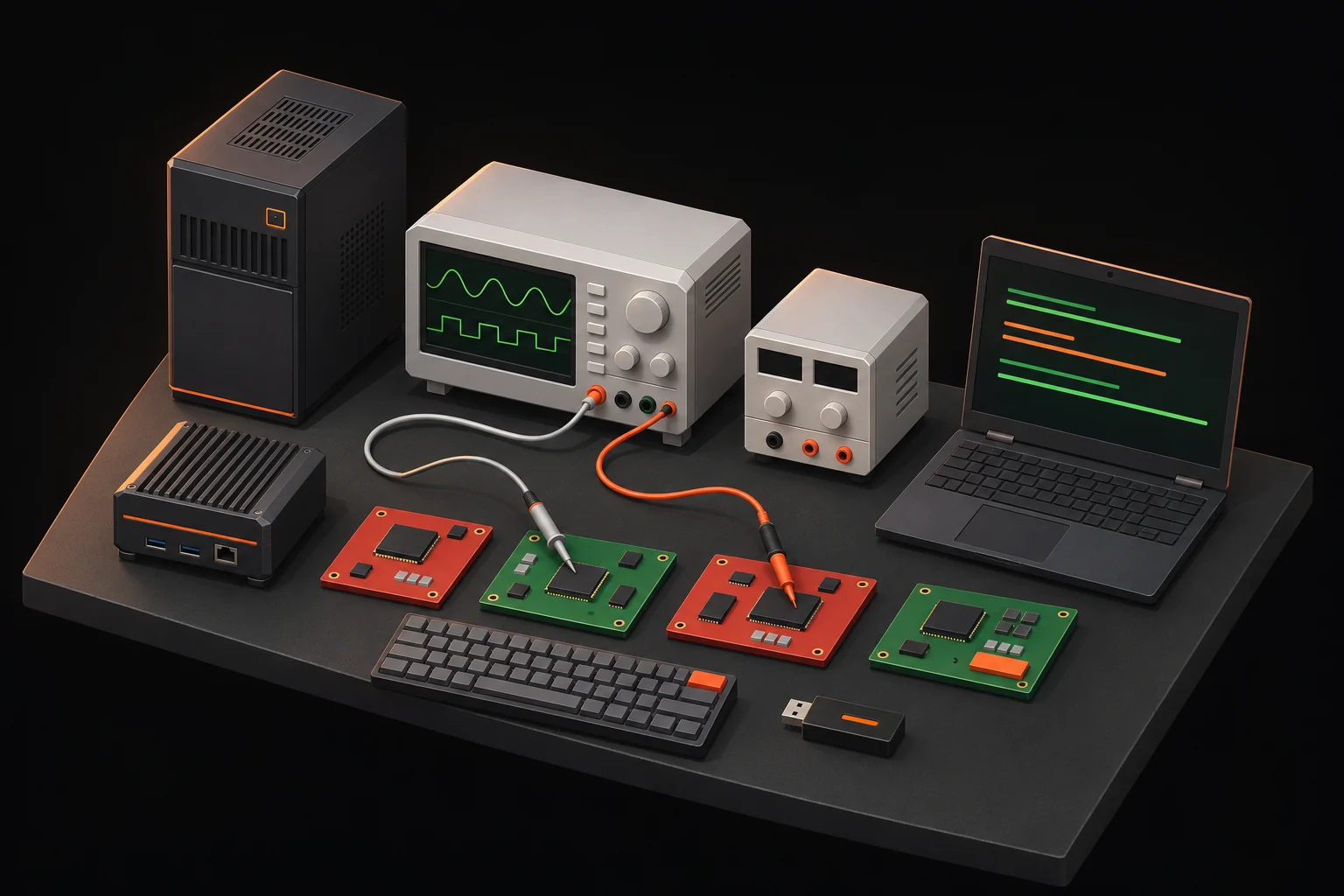
Check how the device starts, protects its firmware, and handles cryptographic operations.
Examine how keys are protected, who can request a signature, and how the device connects to its host.
Document the configuration, observations, and limits so another reviewer can follow the finding.
SIGNING HARDWARE / SUPPLY BY CONTACT
Add signing to an existing host with SIGNET USB, or combine local processing and signing in a Nerve Center appliance.
USB SIGNER
Add signing to an existing host.
A USB signing unit built around the RP2350 and NXP SE050E secure element. Host connection and record formats are agreed for your system.
Email about SIGNET USBEDGE APPLIANCE
Combine local processing and signing.
A local device that processes and signs data from agreed sources. We define which inputs it accepts, which actions need approval, and what happens if something fails.
Email about Nerve CenterWe agree how keys are protected, who can approve actions, how repeated requests are handled, and which records to keep.
Explore client softwareRESEARCH & DEVELOPMENT
Programs in sensing, communications, and field systems. Each has its own development scope; contact us to discuss research or evaluation.
Counter UAS aircraft research, with development and testing scoped to the program.
Discuss MORPHINEA passive detection node for site perimeters, bringing optical, thermal, acoustic, and receive-only RF observations together for review.
Discuss SENTINEL-1Field-network research covering interfaces, timing, and exchange of records between participating systems. Related software integration is explored through N.3.X.U.S OS.
Discuss QFNA modular aperture-array concept for adaptable signal collection and emission.
Discuss LATTICE-ARPropulsion research exploring noise and operating endurance.
Discuss VECTOR-3A rugged field-node concept for multi-band mesh communications and participating system interfaces.
Discuss HEX-NODESTART WITH YOUR SYSTEM
Tell us what you need to assess, integrate, or explore. We confirm scope, configuration, commercial terms, and next steps directly.