
The Space Order · V1.0
PacSec covers the CMMC assessment path. SSX360 maps the same authorization through all six Space Order layers and returns signed evidence a reviewer can check offline. Where we name CMMC, that is evidence mapping, not a certification claim. SSX360 holds no CMMC certification.
- File
- SSX360-CRITERIA-0001
- Class
- PUBLIC
- Collection
- Public record
- Issued
- 25 Aug 2026
- Rev
- V1.0
Method · Named sources, signed evidence, offline verify
Criteria · Operator through Orbit
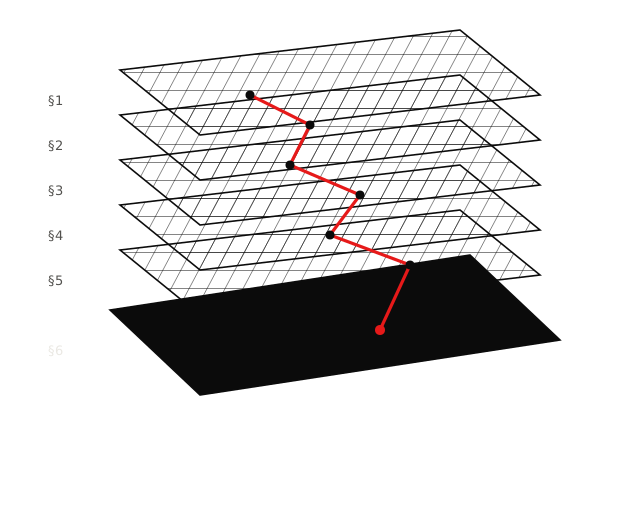
Six layers. Our own criteria.
The Space Order is SSX360's published criteria set. It traces one authorization from the person who granted it, through the surfaces that act and the signatures that bind, down to the clock that dates the whole record.
Compliance checklists stop at the interface. The Space Order continues through signature, ledger, signal, and orbit, so that a reviewer asking the same question a year later can still answer it.
Verification, not opinion.

Operator
Ships in review
Who may act.
Every authorization traces to a person, or to a governed system with an accountable owner. MCV-1.1 asks for that owner and for the record that states the intent.
Maps to · MCV-1.1 intent and accountable owner
Interface
Ships in review
Where authority is exercised.
Consoles, APIs, services, and scripts all act. MCV-1.3 binds the observed identity, action, target, and result back to the authority record that preceded them.
Maps to · MCV-1.3 identity and action binding
Signature
Ships in review
How authority binds.
Signatures bind under MCV-1.0, on ML-DSA and SLH-DSA, which NIST standardised in August 2024 as FIPS 204 and FIPS 205. Constant-time code keeps the signing key out of the timing and power traces.
Maps to · MCV-1.0 criteria and post-quantum migration planning
Ledger
Ships in review
What actually happened.
Receipts carry a number per actor, so a missing one is answerable by counting. MCV-1.5 reports which receipts an actor numbered and never delivered, then stops short of guessing why.
Maps to · MCV-1.5 log completeness and gap detection
Signal
Criteria
The physics underneath.
Correct mathematics still leaks through the hardware that runs it. Minerva recovered ECDSA keys from signature timing in 2020. ISO/IEC 17825 names the power, electromagnetic, and timing tests a Signal review works from, and predictive models track physical-layer drift.
Maps to · Scoped physical-layer review under a written proposal
Orbit
Criteria
What everything stands on.
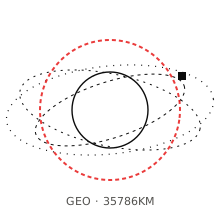
MCV-1.4 asks whether authority held at the moment of the action, which makes the clock evidence. That clock arrives by GNSS, where the UK Blackett Review reported 4.6 interference events a day at a City of London rooftop feeding financial timing.
Maps to · MCV-1.4 timing validity, on reference infrastructure named in scope
Shipping now
- §1–§4 criteria applied through MCV-1, SSX Terminus, and signed evidence packages
- Offline verification for delivered evidence via Matrix Scroll 0.7.0
- Signet-C and Signet-N as supported hardware roots for the issued mark when selected
In progress
- §5 Signal reviews as scoped physical-layer work under a written proposal
- §6 Orbit reference checks for timing and position infrastructure named in scope
- Passive chronometric lab demo at a Honolulu venue under owner control, pending written coordination
Not
- CMMC certification or C3PAO assessment
- Facility clearance or ITAR registration
- A claim that Space Order replaces PacSec program readiness
- Attachment to emergency call routing or carrier systems
The Space Order is published criteria, not an accredited scheme and not a substitute for a C3PAO assessment. Certification under any named framework remains with that framework's accredited assessors.
Document form: typed dossier, industrial print, brutalist structure. Diagrams are original SSX360 work.